
The FBI estimated 779,542 burglaries in the U.S. in 2024. While 52.1 percent involved residential properties, the remaining 47.9 percent involved nonresidential properties. For businesses, that figure highlights why protecting commercial premises remains an important security concern.
These figures show that burglaries affect both residential and nonresidential properties, although the level of risk varies by property and location. For businesses reviewing their security, the bigger question is which type of protection best matches the risks at their property.
When it comes to protecting a company, there are usually two common options. First, remote video monitoring, and second, physical security guards. In this guide, we will help you find out which one is the right choice for your company. So, let’s get started.
Quick Summary
Remote video monitoring can provide broad camera coverage without the ongoing labor cost of staffing each location with guards. Guards, on the other hand, are an expensive option and are useful for handling access control and physical response. Businesses can choose an option based on their current security needs and scalability requirements. Some businesses use both approaches, such as on-site guards where physical interaction is needed and remote monitoring for camera-covered areas or after-hours security.
What Is Remote Video Monitoring?
It is basically a security service where trained operators monitor camera activity from an off-site location. That is why it is also called remote guarding or remote video guards. When the system detects an activity, the monitoring team reviews the event and checks whether it appears legitimate.
Once an operator verifies an event, their next step is to take the right action according to the pre-defined response protocols. That response could be different depending on the system and situation. For example, it may involve:
- Contacting a designated person
- Using a speaker to address someone on the property
- Contacting emergency services
What Does an On-Site Security Guard Do?
The name already makes it clear that “on-site security guards” means someone physically present at the site to ensure protection. A trained guard may have different duties at a commercial property.
For instance, a guard may check credentials at an entrance, patrol a warehouse, and manage visitors. Besides that, their duties may include watching a parking area, opening gates, or dealing with disturbances.
What makes them different from remote guards is their ability to physically handle an emergency situation. For example, they can walk an employee to a vehicle, inspect a door in person, or manage entries at reception.
Remote Video Monitoring vs. Security Guards: Key Differences at a Glance
Here is a quick breakdown of key differences between remote video monitoring and security guards based on various factors:
| Factor | Remote Video Monitoring | On-Site Security Guards |
| Coverage | Visibility into all the areas with cameras | Limited patrol route |
| Detection | In seconds, through analytics | Depends on what the guard sees or hears |
| Physical Presence | No | Yes |
| Live Intervention | May include audio warnings | The guard can respond physically. |
| Cost | $30 to $150 per month per camera | $14.11 to $24.41 per hour for unarmed guards |
| Multiple Locations | Can handle multiple locations easily | Separate guards are required at each site. |
| Evidence | Recorded video and event records | Guard reports plus available camera footage |
| Best for | Perimeters, lots, warehouses, after-hours coverage | Entrances, public-facing sites, hands-on security duties |
How Do Remote Video Monitoring and On-Site Guards Compare?
The best choice depends on how each approach performs against your property’s actual security needs.
Here is a comprehensive comparison of both commercial video monitoring and security guards below:
Coverage and Blind Spots
We all know that a guard can only see the area around them at any given moment. But professional cameras can cover more than that. A well-designed camera infrastructure provides real-time visibility into every important corner of the commercial property.
But that does not mean it cannot have blind spots. Instead, cameras can also miss some points because of poor pavement, walls, and lighting issues.
Threat Detection and Response Time
Video analytics can detect configured activity across multiple camera views and bring relevant footage to an operator’s attention. These setups can use analytics to identify configured events, which allows them to bring relevant footage to an operator’s attention.
An on-site guard has an advantage when an incident requires an immediate physical response at the property. That means remote monitoring may have an advantage in detection, but its response cannot match the level of physical access.
Deterrence and Intervention
Both cameras and physical guards create a visible deterrence, which serves as a warning that the property is under protection. For example, when a burglar or intruder wants to gain unauthorized access to a business, the presence of security guards acts as a clear sign that someone is actively watching the property.
Similarly, cameras also have such a deterrent effect, especially when combined with warning signs and lighting.
Cost and Ongoing Security Expenses
Another area where the difference becomes clear is cost and ongoing expenses. Hiring a single guard or a team is usually more expensive than having someone monitor your camera from a remote location. According to Indeed, the average base rate of security guards in the U.S. is $18.56.
Published estimates commonly place professional remote video monitoring around $50 to $150 per camera per month, although pricing varies by provider and service level. Coverage hours, site activity, and response requirements can also affect the final cost.
Reliability and Human Error
Physically present guards usually have judgment and flexibility, which enables them to notice something unusual that a predefined video rule may never catch.
But at the same time, a person cannot watch every corner of a large business property all the time. Camera analytics can help monitor several configured zones at the same time and flag defined activity for review.
That said, technology also introduces new vulnerabilities. For example, if the camera is positioned poorly or the lenses are dirty, a remote guard cannot see what is happening clearly.
Scalability Across Large or Multiple Properties
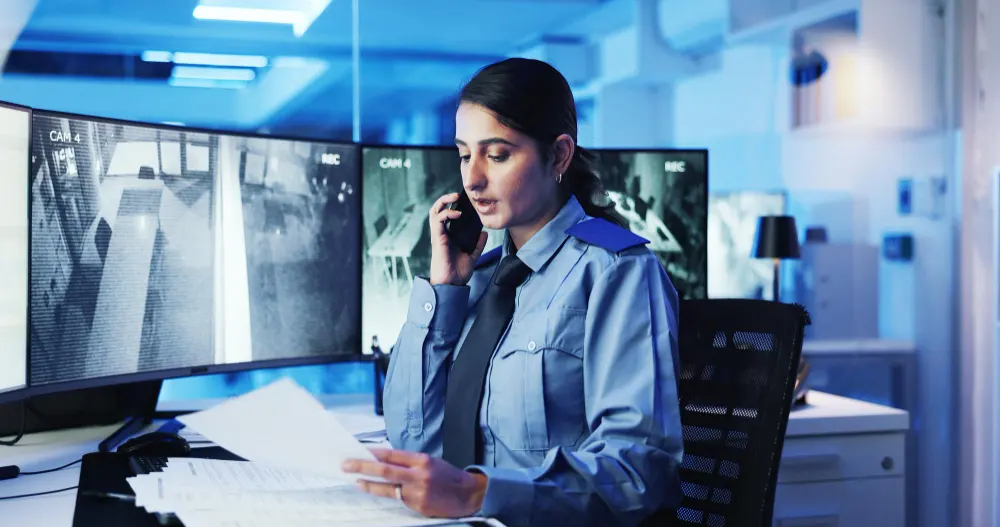
If your company operates at several locations, remote monitoring appears to be a better option compared to security guards. The reason? Cameras from different sites can feed into a centralized monitoring operation, which allows remote monitoring teams to watch all the locations from one place.
Guard staffing can also be scaled when the number of sites increases, but that requires additional investment. For businesses considering security monitoring for commercial properties across several locations, commercial video cameras can reduce the need to staff every monitored area separately.
Incident Verification, Evidence, and Reporting
Commercial security monitoring provides a visual record of all the captured events in the form of digital data. Authorized users can review available footage to understand what happened at a site and identify relevant activity when the video clearly captures it. In fact, they can also preserve the videos to deal with potential disputes in the future.
In comparison, a guard can also provide an incident report and firsthand observations. But if the guard is alone and there are no security cameras, you cannot get visual proof of the event, which is usually more effective for resolving issues.
Pros and Cons of Remote Monitoring and On-Site Security Guards
From the differences mentioned above, it is clear that both options have their own advantages and drawbacks. For someone comparing video surveillance and security guards, it is important to be familiar with both the pros and cons of each safety measure to make the right choice. So, let’s walk through their perks and limitations.
Remote Video Monitoring
Remote video monitoring comes with the following pros and cons:
Pros:
- Ability to monitor nearly the entire site at the same time
- Event verification with both live and recorded footage
- 24/7 protection with faster response times
- More reliable for multi-location companies
- Lower cost and better visibility into all zones
- Easy to scale by just adding cameras and locations
Cons:
- No one on site to intervene physically
- Cannot see areas outside camera coverage
- Requires reliable connectivity
- Need appropriate backup planning
OnSite Security Guards
Here are the advantages and disadvantages of security guard monitoring:
Pros:
- Physical presence during staffed security hours
- Can interact directly with employees, visitors, and contractors
- Ability to patrol and perform other physical duties
- Can respond to an emergency faster than remote guards
- Better judgment in unusual situations
Cons:
- High ongoing cost for round-the-clock coverage
- Covers one area at a time
- Visual evidence depends on whether cameras are also installed
The Final Words
In short, both remote video monitoring and security guards are helpful to protect your business from criminal threats. One offers wide visual coverage, verified alerts, audio intervention, and centralized oversight. In comparison, the other provides physical presence, access management, direct interaction, and in-person response. Businesses can choose any option based on their security needs. You can even combine both options for an extra layer of protection.
If you are planning to get commercial video monitoring services, Elite Security Alarm Systems is here to help. We are a Homestead, Florida, company serving businesses across South Florida since 1997. Our team designs custom security systems with 24/7 monitoring around your hours and budget. Contact us for a free quote.
FAQs
Can remote video monitoring fully replace security guards?
No, it cannot, especially in situations that require physical presence or human interaction. If your business needs check-in access, patrols, and visitor assistance, you will need to hire guards who can physically handle a situation.
Is remote video monitoring cheaper than hiring guards?
In most cases, yes, remote video monitoring turns out to be a cost-effective option compared to security guards. The cost factor is particularly beneficial for businesses that run across multiple locations.
What happens to a monitored system if the power or internet goes down?
A well-designed system sends an alert when a camera or connection drops. Backup power may keep cameras and network equipment running during an outage, but remote monitoring also requires a working communication path. Systems with cellular or other backup connectivity may retain remote communication, depending on their configuration.
Can I keep my current cameras and add monitoring?
Yes, that is a suitable option. In fact, many small businesses use their existing infrastructure of cameras before integrating professional monitoring. However, the cameras only work with a new monitoring setup if they meet the provider’s technical and coverage requirements.
Does Someone Watch the Security Cameras 24/7?
That is completely up to your provider. Some systems use analytics to flag defined events for operator review, so an operator does not necessarily stare continuously at every camera feed.